







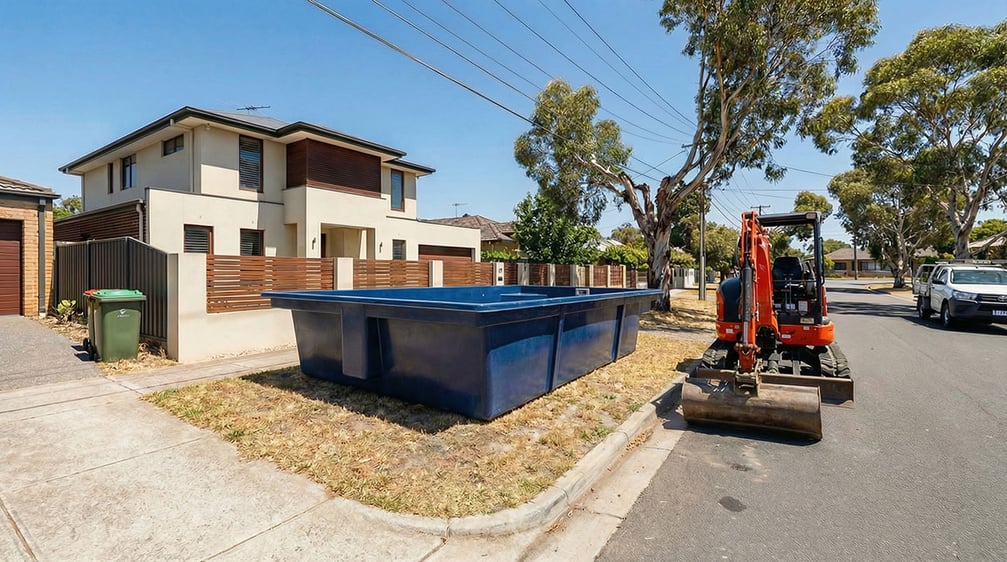
In short: Fibreglass pool installation involves 5–8 standard trades — excavator, crane, plumber, electrician, concreter, fencer — coordinated in sequence. The Australian pool industry's own peak body, SPASA, confirmed to the Australian Treasury that most on-site work is performed by independent subcontractors. These are the same tradespeople homeowners can hire directly, saving $25,000–$43,000 on a typical installation.
Browse any of the big manufacturers and you'll find the same playbook. Shells reinforced with "DuPont™ Kevlar® and Carbon Fiber" — the "same materials in military vehicles and bulletproof vests." Six trademarked technology names for what is, at its core, a moulded fibreglass tub. Teams who "meticulously level the base material."
Base material. Levelled. Meticulously.
You know what base material is? Sand. You know what levelling it involves? A laser level and a long screed board. This is not the Apollo program.
The language is not accidental. It's the mechanism. And understanding how it works will save you somewhere between $25,000 and $43,000 on your next pool.
The jargon is the product
Every industry has complexity. Pools genuinely require licensed tradespeople — you cannot DIY the plumbing, the electrical, or the crane work. That part is real and non-negotiable.
But there's a difference between genuine technical requirements and manufactured mystique.
What does "advanced excavation" actually mean?
"Advanced excavation techniques" means a standard hydraulic excavator with a laser level. The same equipment, operated by the same type of contractors, used to dig house footings and retaining walls every single day across Australia.
What is "engineered backfill"?
"Engineered backfill" means filling the gap between the pool shell and the excavated wall in layers and compacting it. This is a standard civil construction practice — it's in every foundation specification because building codes require it, not because pool companies invented it.
What does "precision shell placement" involve?
"Precision shell placement" means a crane lifts the pool into position, checks it's level (within ±5mm), and the crane leaves. The crane hire costs $800–$3,000. The process takes half a day.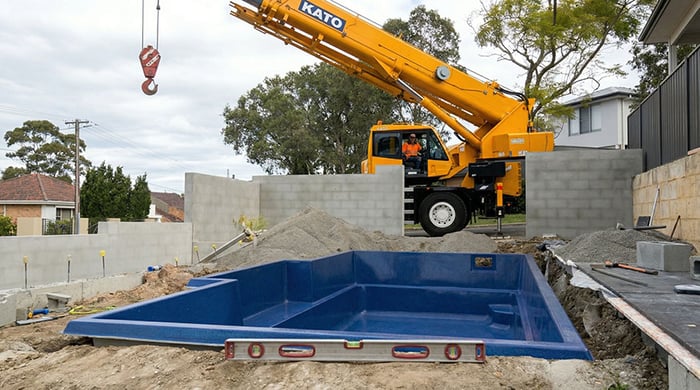
Compare this to how DIY pool kit suppliers describe the same work. One tells potential customers: "From skilled tradespeople to office workers who might struggle to identify a hammer, anyone can successfully install a fibreglass pool." Another summarises the entire installation as: "Basically, you need to dig a hole big enough to accept the swimming pool, lower in the fibreglass swimming pool, connect the swimming pool plumbing, backfill the hole and install whatever coping or decking you need."
The distinction matters: "installing" in this context means coordinating licensed tradespeople, not performing licensed work yourself. The plumbing and electrical still require licensed contractors — the owner's role is project management, not pipe fitting.
Same physical process. Two completely different stories about who's capable of overseeing it.
The industry's own peak body gave the game away
Here's the detail that pool company marketing departments would prefer you never read.
The Swimming Pool & Spa Association of Australia — SPASA, the industry's own peak body — submitted a formal document to the Australian Treasury in 2019. In it, they explained why pool companies should be classified as small businesses despite sometimes appearing large. Their reasoning was revealing.
They wrote that in the swimming pool industry, it is "not unusual for a larger pool building or service company to have relatively few fulltime employees whilst most of the on-site construction and infield activity is performed by independent subcontractors."
Read that again. Most of the on-site work is performed by independent subcontractors.
The tradies digging the hole, running the plumbing, and wiring the equipment are not pool company employees. They're independent operators — the same excavators, plumbers, and electricians who take on work from whoever calls them. The pool company's role is to be the intermediary who calls them on your behalf and marks up that call significantly.
The evidence goes further. One of Australia's largest pool franchises actively markets to customers that their franchisees handle installations "in-house, without the involvement of subcontractors." Think about what that framing reveals. You only advertise no subcontractors as a point of difference when subcontractors are the industry norm.
Consumer accounts on Whirlpool forums confirm what the industry's own documentation shows. One customer of a major pool brand described it plainly: "All what the pool company does is they hire a gang of concrete guys, pavers guys, and plumbers and pay them peanuts and make an extra profit by organising work like any builder."
The person installing your $70,000 pool is — by SPASA's own account — the same independent tradesperson you could find on any local directory. The pool company is a scheduling layer between you and them, with a substantial markup attached.
How much does the pool company markup actually cost?
Three Birds Renovations, one of Australia's most-referenced renovation cost databases, puts labour at 40–50% of total pool project cost. On a $70,000 pool, that's $28,000–$35,000 going to coordination, management, and trade work.
That $28,000–$35,000 doesn't go to the excavator. It doesn't go to the plumber or electrician. A significant portion of it goes to a company whose core function, as confirmed by their own industry body, is to arrange independent tradespeople on your behalf.
| Cost Component | Pool Company Quote | Owner-Coordinated | Saving |
|---|---|---|---|
| Pool shell (retail vs direct) | $18,000–$25,000 | $8,000–$15,000 | $10,000–$15,000 |
| Trade labour (excavation, plumbing, electrical, concrete, fencing) | $28,000–$35,000 | $15,000–$22,000 | $5,000–$8,000 |
| Project coordination & management fees | $7,000–$10,000 | $0 (your time) | $7,000–$10,000 |
| Equipment (pump, filter, chlorinator) | $5,000–$8,000 | $3,000–$5,000 | $2,000–$3,000 |
| Permits & council fees | $2,000–$4,000 | $2,000–$4,000 | $0 |
| Typical Total | $60,000–$82,000 | $28,000–$46,000 | $25,000–$43,000 |
Based on a standard 7m–8m fibreglass pool with standard access. Costs vary by region, site conditions, and pool model. Figures sourced from consumer reports, Three Birds Renovations, and Swimming Pool Kits Direct project data (2024–2026).
Consumer accounts consistently document savings of $20,000–$40,000 for owner-coordinated installs. In some cases — particularly where the homeowner also handles finishing trades like paving, landscaping, and fencing — total savings exceed 50% compared to a turnkey quote.
The pool isn't cheaper. The trades aren't cheaper. You're simply removing the layer between you and them.
"But what happens when something goes wrong?"
Here's where most people stop reading and start rationalising.
"If this were really that simple, wouldn't everyone do it? And when something goes wrong, who's accountable? At least with a pool company, I have someone to call."
That's the objection. It's also the most interesting part of this story.
Do owner-built pools have more defects than professionally installed ones?
SPASA actively warns homeowners against coordinating their own pool installation. Their Victorian CEO has published consumer alerts cautioning that owner-builders can be exposed to insurance gaps, liability for worker injuries, and defect responsibility on resale.
These are legitimate points and worth understanding before you proceed. Owner-builder permits have specific requirements in each state, and the liability structure differs from a commercial install. This is real, not scare-mongering.
But there's something missing from SPASA's warnings: any data showing that owner-coordinated pools have worse quality outcomes than commercially installed ones.
SPASA has not published defect rates. They have not published complaint data. No Australian regulator — not NSW Fair Trading, not the QBCC, not the VBA — tracks first-inspection pass rates by installation method. The only peer-reviewed Australian evidence on the question — a 1999 study by Georgiou, Love, and Smith — found no significant difference between owner-builder and registered builder quality outcomes. It covers housing generally rather than pools specifically, and it's 27 years old. But it remains the only published data on the topic, and it doesn't support the industry's narrative.
SPASA lobbies the VBA to restrict owner-builder activity, raising concerns about "owner builders proliferating the industry." That language — proliferating — is not a safety concern. It's a commercial one. The organisation that represents pool builders commercially opposes the model that removes pool builders from the transaction. That conflict of interest doesn't make their safety points wrong. But it does mean their advocacy should be weighed in context.
The professional installation pathway is not immune to problems either. QBCC dispute cases increased 34.6% over the past decade. The VBA penalised two well-known pool companies a combined $22,000 in 2022 for permit and fencing violations. In 2022, 63% of NSW building complaints related to "defective or incomplete work."
The complexity — and the risk — doesn't disappear when you pay a pool company. It changes form. You're trading the risk of managing the process for the risk of managing a dispute after the fact.
What does owner-coordinated pool installation actually involve?
A fibreglass pool installation is a sequenced process, not a simultaneous one. Trades work in order. When one phase finishes, the next starts. This makes it one of the more manageable large-scale projects a homeowner can oversee — fewer parallel decisions than a kitchen renovation, clearer sequence, less daily disruption.
| What They Call It | What It Actually Is |
|---|---|
| Advanced excavation techniques | Standard excavator with a laser level |
| Engineered backfill | Layered fill and compaction — in every foundation spec |
| Precision shell placement | Crane lowers pool, checks level to ±5mm, leaves |
| Proprietary shell technology | Fibreglass moulding with brand-name materials |
| Meticulous base preparation | Screeding sand flat with a straight edge |
The actual trades involved number between five and eight: excavator, crane hire, licensed plumber, licensed electrician, concreter, fencing contractor, and optionally a landscaper. A mid-range kitchen renovation typically involves seven to ten trades with more complex sequencing and no equivalent in council permits.
What two questions should you ask every pool contractor?
Your job isn't to become a tradesperson. You probably already coordinate more complex logistics than this — school runs, medical appointments, tradies for other jobs. The difference here is knowing which two questions separate a competent pool contractor from a $15,000 mistake.
The first: what backfill material do you use? The correct answer is 8:1 sand/cement dry mix or cement-stabilised crusher dust. If they say dirt, sand, or "whatever we dig up," walk away. Wrong backfill causes $15,000–$30,000 in shell movement within three years.
The second: how far from the pool will you place the equipment? The ideal answer is 3.5–8 metres. Too close creates noise. Too far causes pump cavitation.
Those two questions, combined with calling three references and verifying current licenses, separate a competent installation from a costly one. No industry-specific expertise required.
A note on where you live: owner-builder permits in NSW, QLD, and VIC allow you to coordinate licensed trades on your own project, with specific permit and course requirements in each state. ACT is the exception — pool construction there requires a licensed builder with a pool endorsement by law. Check your state's requirements before proceeding. Links to each state's permit process are below.
The experts are already in your street
The industry is right, in a narrow sense. If you believed everything on their websites, pool installation would feel like rocket science. It would require specialists with proprietary technology and decades of institutional knowledge unavailable to the public.
But the Swimming Pool & Spa Association of Australia told the Australian Treasury the truth: most of that work is done by independent subcontractors. The same ones you drive past every day. The same ones who will talk to you directly, work on your schedule, and charge you the trade rate rather than the builder rate.
The rocket scientists are waiting for your call. They just normally get it from a middleman first.
Frequently Asked Questions
How much can you save with a DIY pool installation?
Homeowners who coordinate their own fibreglass pool installation typically save $25,000–$43,000 compared to a full-service pool company quote. A traditional turnkey installation runs $70,000–$85,000, while a DIY-coordinated install comes in at $35,000–$45,000. If you purchase a pool kit and hire a licensed installer directly, total costs sit around $33,000–$43,000. The savings come from three areas: buying the shell direct (saving $10,000–$15,000 in retail markup), eliminating project coordination fees ($7,000–$10,000), and sourcing independent contractors at competitive rates ($5,000–$8,000). Your time investment is roughly 8–15 hours spread across 8–12 weeks — most of that is phone calls and site visits, not physical labour. Use our Pool Price Calculator for a specific estimate, or see our full cost breakdown.
What trades do you need to install a fibreglass pool?
A fibreglass pool installation requires five to eight trades, working sequentially rather than simultaneously. The core trades are: an excavator operator ($2,500–$4,000 for standard access), a crane operator or Franna hire for shell placement ($800–$3,000), a licensed plumber for Class 9 pressure pipe installation ($2,000–$3,500), a licensed electrician for power, bonding, and lighting ($1,500–$2,500), and a concreter for the bond beam and coping ($4,500–$8,000). You'll also need a fencing contractor ($3,000–$5,000) and optionally a landscaper. Each trade finishes before the next starts, making the sequencing simpler than a kitchen renovation where multiple trades overlap. See what's included in each pool kit.
Is it legal to install your own pool in Australia?
Yes, in most states. Owner-builder permits allow you to coordinate licensed tradespeople on your own residential project. In NSW, you need an owner-builder permit if you're managing two or more contractors on work valued over $10,000. In Queensland, the threshold is $11,000. In Victoria, you need a Certificate of Consent for work over $16,000. The ACT is the exception — pool construction there requires a licensed builder with a pool endorsement by law. Permit costs run $1,500–$3,000 plus $700–$1,200 for owner-builder requirements. The critical distinction: you are coordinating licensed tradespeople, not doing the licensed work yourself. All plumbing, electrical, excavation over 1.5 metres, crane operation, and pool barrier installation must be performed by appropriately licensed contractors. For a step-by-step walkthrough, see our guide to building a DIY pool.
What backfill should you use for a fibreglass pool?
The correct backfill is an 8:1 sand-to-cement dry mix or cement-stabilised crusher dust. This is non-negotiable — using dirt, plain sand, native soil, or "whatever we dig up" causes $15,000–$30,000 in shell movement and structural damage within three years. The backfill is placed in layers while the pool is simultaneously filled with water, keeping the water level at least 300mm above the backfill level at all times. The mix should not be wetted or compacted during installation — it sets naturally through moisture absorption. Only pack the mix under step areas. This is the single most important quality checkpoint in a fibreglass pool installation, and the first question you should ask any contractor you're considering hiring.
Want to see the full cost breakdown before approaching any pool company or trades directly? Use our Pool Price Calculator to get a real number for your specific pool size and configuration — no salesperson involved. Then read our Fibreglass Pool Buying Guide or getting started guide for your next steps.
State permit resources: NSW Owner-Builder Permit | QBCC Owner-Builder Permit QLD | VBA Certificate of Consent VIC | ACT Licensed Builder Requirements
About the author: Colm Walsh is the Managing Director of Swimming Pool Kits Direct. A former national-level competitive swimmer and water polo captain at University College Cork, he spent 20+ years in digital and e-commerce leadership at Amazon, Accenture, NAB, and Optus before acquiring the business in 2020. Swimming Pool Kits Direct has delivered thousands of fibreglass pool kits to Australian families over the past 10+ years. Learn more about our team.
.png?width=400&height=266&name=Cape%20Classic%20(1).png)
.jpeg?width=400&height=266&name=6m%20Slimline%20Medium%20Blue%20Above%20Ground%20(2).jpeg)
.png?width=400&height=266&name=Blog%20Images%20(24).png)
