







Your last trip to IKEA took three hours. You drove there, got lost somewhere between kitchens and textiles, argued briefly about a lamp, waited twenty minutes for someone to find the flatpack you needed from the warehouse, then sat in traffic on the way home.
Nobody called that "project management." Nobody said you needed a construction background to pull it off. You just... did it.
Coordinating a fibreglass pool installation — the part that pool companies charge $25,000–$40,000 to do for you — takes less time than that IKEA trip. Under two hours of actual phone calls, spread across 8–12 weeks. The rest of your involvement is showing up at the right moments, asking two specific questions, and letting tradespeople do what they do every week without you.
We know that sounds like an exaggeration. It isn't. Here's every call, timed.
The calls before you've committed to anything
Before a single cubic metre of dirt moves, you need information. This is the research phase, and most of it happens from your couch.
Call 1: Dial Before You Dig — 5 minutes. You ring 1100. Free service. They mark where underground utilities run through your property. You need this before anyone quotes excavation, because hitting a gas line turns a $3,000 dig into a $30,000 disaster. The call itself is a recorded message, a few details about your property, done.
Call 2: Your local council — 10 minutes. You're asking one question: "What approval pathway applies to a fibreglass pool installation at my address?" In NSW, the answer is usually a Complying Development Certificate (CDC) — 20-day fast-track. In QLD, Accepted Development can clear in 24 hours with complete documentation. In VIC, VicSmart handles most standard pools. The council officer will tell you which path applies. You don't need to understand planning law. You need to write down the answer. For more on the planning phase, see our guide to planning your DIY fibreglass pool.
Call 3: Private certifier — 10 minutes. If your council points you toward a CDC or fast-track pathway, a private certifier handles the approval. This call is simple: "I'm installing a fibreglass pool at [address], my supplier provides engineering drawings and council documentation — can you handle the approval and what do you charge?" Most quote $700–$1,200. Book them.
Calls 4–6: Pool suppliers for quotes — 30 minutes total. Three calls, ten minutes each. You already know what size pool fits your space. You're asking about shell price, equipment packages (Signature, Platinum, or Fresh Water), what's included in the documentation pack, and delivery timeframes. A quality supplier includes engineering drawings, bond beam details, and state-specific council forms — saving $500–$1,000 in drafting fees and weeks of approval time. Not sure what's included? See what to expect when you buy a DIY pool kit.
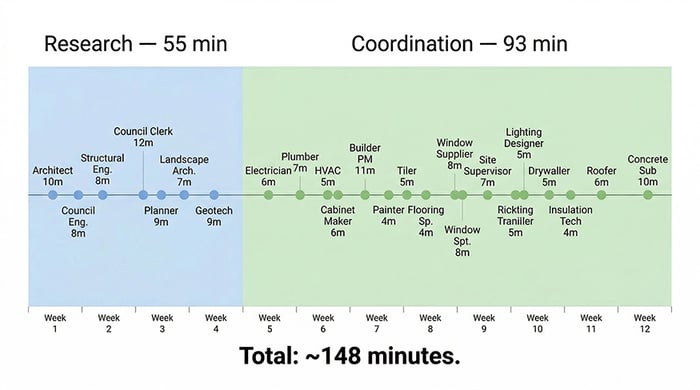
Pre-commitment phone time: roughly 55 minutes.
You haven't coordinated a single trade yet. You've made six calls. You now know your approval pathway, your certifier is engaged, and you've got comparable quotes. That's more preparation than most people do before hiring a kitchen renovator.
The calls that pool companies charge $25,000 for
This is the part that stops people. The "coordination." The word itself sounds like it requires a clipboard, a whiteboard, and a talent for logistics.
Here's what it actually involves.
Calls 7–9: Excavators — 24 minutes total. Three calls, eight minutes each. You're getting quotes from excavation contractors. The conversation goes like this: "I need a hole dug for a fibreglass pool. I have engineering drawings with exact dimensions. Standard residential access. Can you quote it and when are you available?"
They'll ask about access width, soil type (if you know it), and whether you want them to cart the spoil away. Excavation runs $2,500–$4,000 for standard access. If they ask about your pool dimensions, your documentation pack has every measurement. You're reading numbers off a page, not engineering a foundation.
Call 10: Crane or Franna operator — 8 minutes. Your pool shell gets delivered curbside by the supplier.We include delivery on all pool shells to QLD, NSW, VIC and ACT. See if we deliver to your area.
Getting it from the curb to the hole is a crane job. "I need a fibreglass pool shell lifted from the street into an excavation in my backyard. Here are the dimensions and the access width. Can you quote it?"
Crane hire runs $800–$3,000 depending on access difficulty. The operator will want to know the shell weight (your supplier provides this) and the distance from street to hole. One call. One quote. Done.
Call 11: Licensed plumber — 10 minutes. "I need pool plumbing installed — skimmer to pump, returns, pressure testing. Fibreglass pool, here are the specs." Class 9 pressure pipe, 50mm from skimmer to pump, 40–50mm returns. You're reading those specs from your documentation pack, not from memory. The plumber knows what they mean — they install pools regularly.
This is the call where you ask the first of two critical questions. Not because you need to understand the technical answer, but because the answer tells you whether this plumber knows pool work.
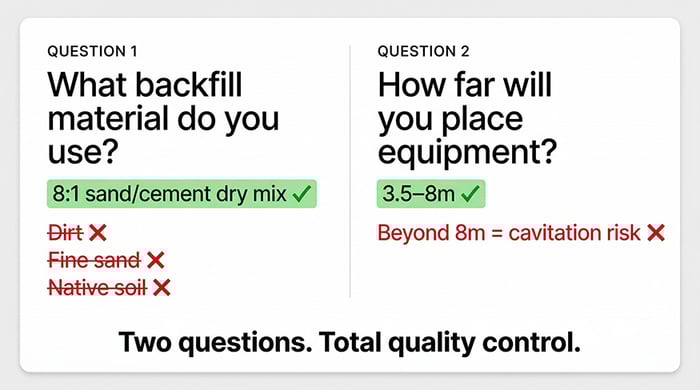
"What backfill material do you recommend around the shell?"
Correct answer: 8:1 sand-to-cement dry mix, or cement-stabilised crusher dust. If they say dirt, fine sand, or "whatever comes out of the hole," thank them for their time and hang up. Wrong backfill causes $15,000–$30,000 in shell movement within three years. That single question — eight words — is worth more than most pool company "project management."
Call 12: Licensed electrician — 10 minutes. Power supply to the equipment pad, bonding, lighting if you want it. Lights are recommended 300–400mm below the water surface. Budget $1,500–$2,500. Same call structure as the plumber: specs from documentation, quote, availability.
Here's where you ask the second question — this time about equipment placement.
"How far from the pool will you position the equipment pad?"
The ideal answer is 3.5–8 metres. Equipment can go further than 8 metres if needed, but beyond that distance your pump needs to be roughly 0.5hp larger to prevent cavitation — air bubbles forming in the pipes that damage the pump over time. Your supplier can configure equipment for any distance, but keeping it under 8 metres is preferred.
Two questions. One about backfill material, one about equipment distance. That's what separates a $42,000 pool that lasts 25 years from a $42,000 pool that costs $15,000 in repairs within three.
Call 13: Concreter for the bond beam — 10 minutes. The bond beam is reinforced concrete poured around the top of the pool after backfilling — 400mm wide, specs on the engineering drawings. "I need a bond beam poured to these engineering specs. Can you quote it?"
Call 14: Fencing contractor — 8 minutes. Pool fencing is legally required. Glass runs $250–$350 per linear metre, aluminium $100–$120, and Pool Perf (perforated aluminium panels) $150–$200. You're getting a quote and a timeline. The fencing goes in after coping and decking.
Calls 15–19: Sequencing confirmations — 15 minutes total. Five short calls across the build, averaging three minutes each. These are the calls that confirm the next trade is ready to start: "Excavation's done, can you come Tuesday for the crane?" and "Plumber's finished and pressure tested, concreter can you start Thursday?" Each trade knows what comes before and after them. They do this sequence regularly. You're confirming dates, not directing traffic.
Call 20: Pressure test confirmation — 3 minutes. Your plumber pressure-tests the pipes before any concrete or decking goes over them. You want this documented. "Can you send me the pressure test results?" One call. Critical — because discovering a leak after the deck is poured costs $5,000–$15,000 to fix.
Call 21: Final inspection — 5 minutes. Ring your certifier to book the final inspection for the Certificate of Occupancy. They come out, verify everything meets the approved plans, and sign off.
Post-commitment phone time: roughly 93 minutes.
Ninety-three minutes. That's fifteen calls spread across 8–12 weeks. An average of one or two calls per week, most of them under ten minutes, none of them requiring any knowledge you don't already have in your documentation pack. For more practical advice on the build process, see our tips for building a DIY pool in Australia.
You're not buying this
Right about here, you're doing the mental calculation that everyone does. Sure, the phone calls are short. But what about the stuff between the calls?
What about standing in the yard supervising excavation? What about being there when the crane places the shell? What about all the decisions you don't know you're supposed to make — the moment the excavator hits rock, or the plumber asks a question you can't answer, or something goes wrong and you freeze because you're not a pool builder?
That's the real fear. Not the phone calls. The gaps. If that's where your head is, hear from homeowners who've done it.
Here's what the gaps actually look like.
The total time investment across the entire 8–12 week project runs 8–15 hours. That includes the calls above and all supervision time. Excavation day: 2–3 hours of being present, mostly watching a machine work while the smell of freshly turned clay hangs in the air. Shell placement day: 3–4 hours, because you need to be there when the crane sets the shell and you need to verify it's level within ±5mm before the crane leaves. Repositioning costs another $800 or more, so this is the one moment your physical presence genuinely matters.
The rest? Periodic checks during backfilling. A walkthrough with the plumber. Being home when the electrician needs access.
The decisions that feel terrifying in advance are almost entirely handled by two things you already have: the documentation pack from your supplier (which contains engineering drawings, bond beam specs, and council forms) and those two questions you asked during quoting (which already filtered out any contractor who doesn't know pool work).
The trades themselves fill the remaining gaps. An excavator who digs pool holes every week doesn't need you to tell them how to shape the floor — they need your engineering drawings, which you hand over. A plumber who runs pool pipework regularly doesn't need you to explain pressure pipe classes — they need your specs, which you read from a page.
As we wrote in our previous post on pool installation complexity, SPASA — the pool industry's own peak body — told the Australian Treasury in a 2019 submission that most on-site pool construction is performed by independent subcontractors. The same independent tradespeople you're now calling directly. The pool company was never doing the work. They were making the calls. The same calls you just read, totalling under two hours.
The six moments you physically show up
Your body needs to be at the property six times across the project. Not daily. Not weekly. Six times.
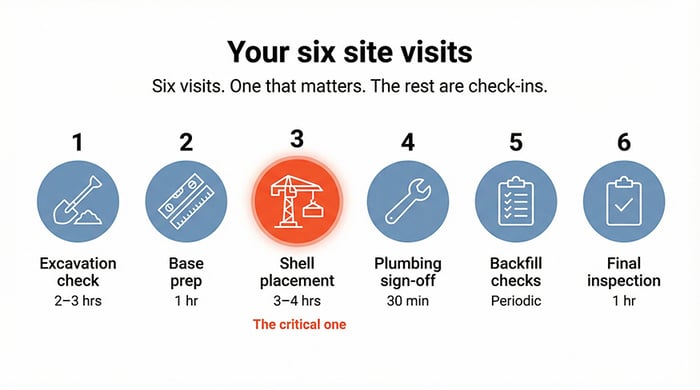
Moment 1: The excavation check. Excavation day. You watch the hole get dug, which takes a few hours. Your job is to have the engineering drawings accessible and to confirm the dimensions look right — 80mm wider than the shell on each side, depth matching the shell plus 150mm for the sand bed. The excavator knows this. You're a second pair of eyes, not a foreman.
Moment 2: Base preparation. The base material goes down — coarse river sand or crusher dust, never fine sand or native soil. Spread 150mm thick, screeded level. Allow a 40–50mm concave dish in the floor for pressure relief (25mm in smaller pools). Your installer or excavator handles the screeding. You're confirming the material is correct, which takes a glance.
Moment 3: Shell placement. This is the big one. Crane day. Be there for the full 3–4 hours. The shell gets lifted from the curbside, carried to the hole, and lowered in. The spreader bar keeps the shell from flexing under its own weight — you can hear the fibreglass creak slightly as it clears the fence line. Before the crane leaves, check that the shell is level within ±5mm. Use a spirit level or water level. If it's off, the crane repositions now — not after it's driven away. This is the only moment in the entire project where your presence directly prevents an expensive mistake.
Moment 4: Plumbing and electrical sign-off. Quick walkthrough. Confirm the pressure test is documented. Confirm equipment pad placement is within spec. Thirty minutes.
Moment 5: Backfill checks. During backfilling, periodic checks that the water level in the pool stays 300mm above the backfill level outside it. The pool fills with water while backfill goes in around it — they rise together. You can place about 200mm of backfill around the base before starting to fill, just to hold the shell in position. If backfill gets ahead of water, external pressure can distort the shell. Your contractor knows this. You're verifying, not instructing.
Moment 6: Final inspection. The certifier comes, checks everything against the approved plans, issues the Certificate of Occupancy. You're present to open the gate.
Six site visits. Most under two hours. One — crane day — requiring your full attention for half a day. The rest are confirmation, not management.
What two hours of calls actually replaces
Get a quote from a traditional pool company for a standard 7-metre fibreglass pool with mid-range equipment. It'll come back between $70,000 and $85,000. Now price the same pool through owner coordination — same shell, same equipment package, same licensed trades. That comes in at $35,000–$45,000 for the same configuration. The difference — $25,000–$40,000 — is the coordination layer you just read about.
There's also a middle path. Buy the shell and equipment direct, then hire a single licensed installer to handle the full build. That comes in at $33,000–$43,000 — less hands-on than full coordination, with most of the savings intact.
Here's how the three approaches compare:
| Approach | Total Cost* | Your Time | Best For |
|---|---|---|---|
| Traditional pool company | $70,000–$85,000+ | Minimal | Hands-off, need financing paperwork handled |
| DIY kit + licensed installer | $33,000–$43,000 | ~4–6 hours | Want savings with single point of accountability |
| Full owner coordination | $35,000–$45,000 | 8–15 hours over 8–12 weeks | Maximum savings, comfortable calling trades |
*Indicative pricing for a standard 7-metre fibreglass pool with mid-range equipment. Costs vary significantly by pool size, model, spa inclusions, and equipment selections — some configurations (particularly with spas and premium equipment) can exceed $60,000. Only a qualified installer can provide exact pricing for your specific project. Use our pool price calculator for a personalised estimate. Not sure fibreglass is right? Compare fibreglass vs concrete pools.
Larger projects with spas and premium equipment naturally cost more either way, but the percentage saving holds. You're removing the same markup regardless of pool size. For a detailed breakdown of fibreglass pool costs in Australia, see our full pricing guide.
The difference isn't a different pool. It's not different trades. It's not different materials or different engineering. As SPASA confirmed, most of the on-site work is done by independent subcontractors regardless of who coordinates them.
The difference is who makes the calls.
All pricing is indicative only. Pool shell and equipment costs vary based on pool size, model, spa inclusions, and equipment selections. Only a qualified installer can provide exact pricing for your specific project.
Back to IKEA
Your last trip there took three hours, cost you an argument about a lamp, and ended with a flatpack you still haven't assembled. Nobody called it complicated. Nobody suggested you needed a professional IKEA coordinator. You just went, made decisions with imperfect information, and came home with what you needed.
Coordinating a pool installation is twenty-one phone calls, a documentation pack that answers the technical questions, and two questions that sort good contractors from expensive mistakes. The phone screen at the end of it won't show a dramatic total. It'll show a series of short, ordinary calls — the kind you make when booking any trade for any job.
The $25,000 phone call was never complicated. It was just never itemised.
Want a more detailed breakdown including the differences between fibreglass and concrete pools, saltwater or mineral pool or equipment packages, download our Ultimate Pool Buying Guide. Or explore our learning centre for more guides on every stage of the process.
Frequently Asked Questions
How much does a fibreglass pool cost in Australia?
A fibreglass pool in Australia costs $35,000–$45,000 with owner coordination, $33,000–$43,000 with a DIY kit plus licensed installer, or $70,000–$85,000+ through a traditional pool company. Costs vary significantly by pool size, model, spa inclusions, and equipment — some configurations with spas and premium equipment exceed $60,000. Only a qualified installer can provide exact pricing for your specific project. Use our pool price calculator for a personalised estimate.
How long does it take to coordinate a fibreglass pool installation yourself?
The total phone time for owner-coordinated pool installation is under two hours — roughly 21 calls spread across 8–12 weeks. Total time investment including site supervision is 8–15 hours over the project. Most calls are under 10 minutes and involve reading specifications from the documentation pack provided by your supplier.
How much can I save by coordinating my own pool installation?
For a standard 7-metre fibreglass pool with mid-range equipment, owner coordination saves $25,000–$40,000 compared to a traditional pool company quote. A pool company typically quotes $70,000–$85,000, while the same pool coordinated by the owner costs $35,000–$45,000. The percentage saving holds across different pool sizes and configurations — use our pool price calculator for a personalised estimate.
What trades do I need to coordinate for a fibreglass pool installation?
A fibreglass pool installation requires five to eight trades working in sequence: excavator, crane or Franna operator, licensed plumber, licensed electrician, concreter (for the bond beam), and fencing contractor. Optionally, a landscaper and paving contractor for finishing work. Each trade works in order — when one phase finishes, the next starts.
What questions should I ask pool installation contractors?
Two questions separate competent pool contractors from costly mistakes. First: "What backfill material do you use?" — the correct answer is 8:1 sand-to-cement dry mix or cement-stabilised crusher dust. Wrong backfill causes $15,000–$30,000 in damage within three years. Second: "How far from the pool will you place equipment?" — ideal placement is 3.5–8 metres. Beyond 8 metres requires a larger pump to prevent cavitation.
Do I need to be on-site every day during pool installation?
No. Owner-coordinated pool installation requires six site visits across the entire project: excavation check (2–3 hours), base preparation (1 hour), shell placement by crane (3–4 hours — the critical one), plumbing and electrical sign-off (30 minutes), periodic backfill checks, and final inspection. Shell placement day is the only moment where your presence directly prevents an expensive mistake.
What is a documentation pack for a fibreglass pool?
A documentation pack is provided by quality pool kit suppliers and includes engineering drawings, bond beam specifications, and state-specific council application forms. It saves $500–$1,000 in drafting fees and speeds council approval by 2–3 weeks. The documentation pack contains all the technical specifications you need to brief each trade — you read the numbers from the page rather than needing construction knowledge. Learn more about what's included.
For more questions, see our FAQs.
About the Author
Colm Walsh is the Managing Director of Swimming Pool Kits Direct. A former national-level competitive swimmer and water polo captain at University College Cork, he spent 20+ years in digital and e-commerce leadership at Amazon, Accenture, NAB, and Optus before acquiring the business in 2020. Swimming Pool Kits Direct has delivered thousands of fibreglass pool kits to Australian families over the past 13+ years. Learn more about our team.
Want to see what the actual numbers look like for your specific pool? Use our Pool Price Calculator to get a real cost range — no phone call required. Or call us on 1800 497 421 to talk through the coordination pathway. We'll tell you exactly what's involved, because you just read most of it.
.png?width=400&height=266&name=Cape%20Classic%20(1).png)
