







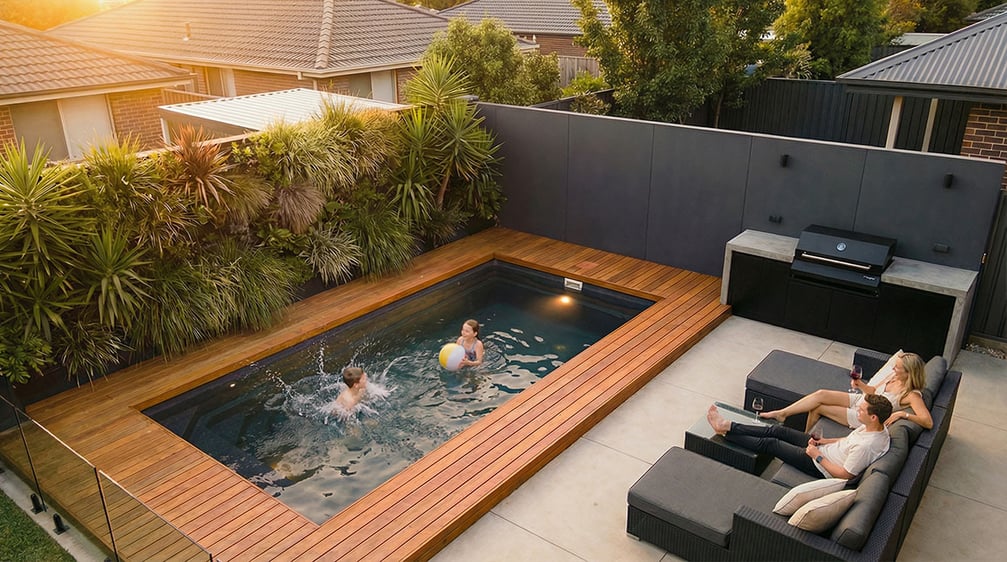
You're standing in your backyard with a tape measure. The numbers aren't wrong—you've checked twice. Maybe three times. This is it: the space where the pool needs to fit, the entertaining area needs to work, and some version of the Australian outdoor dream needs to happen.
It feels small. Because it is small.
Your parents' place had room for a Hills Hoist, a veggie patch, a shed, and a kidney-shaped pool with a deep end for bombing. You've got... this. And somewhere in the back of your mind, a question you haven't quite voiced: Is choosing a fibreglass pool just accepting that the dream got smaller?
Here's the thing - you're not standing at the end of a decline. You're standing at the end of a 50-year evolution. And that tape measure isn't showing you what's left of the Australian backyard. It's showing you what the Australian backyard became.
The quarter-acre block wasn't the dream. It was the starting point.
In the 1970s, the average suburban lot in Sydney, Melbourne, or Brisbane ranged from 600 to 800 square metres. Some outer suburbs still offered the legendary quarter-acre—1,012m² of space where a single-storey brick veneer home occupied maybe 25% of the land. The rest? That was yours. Clothesline territory. Cricket pitch. Chook run. And if you'd really made it, a concrete pool.
Those pools were serious infrastructure. Kidney-shaped or freeform, finished in painted concrete that faded chalky in the sun, surrounded by brick coping that scorched bare feet in January. Deep ends of 2 to 2.5 metres were standard because diving boards weren't just allowed—they were expected. Installation took months. Costs were significant. Concrete pools were what success looked like, poured into the ground.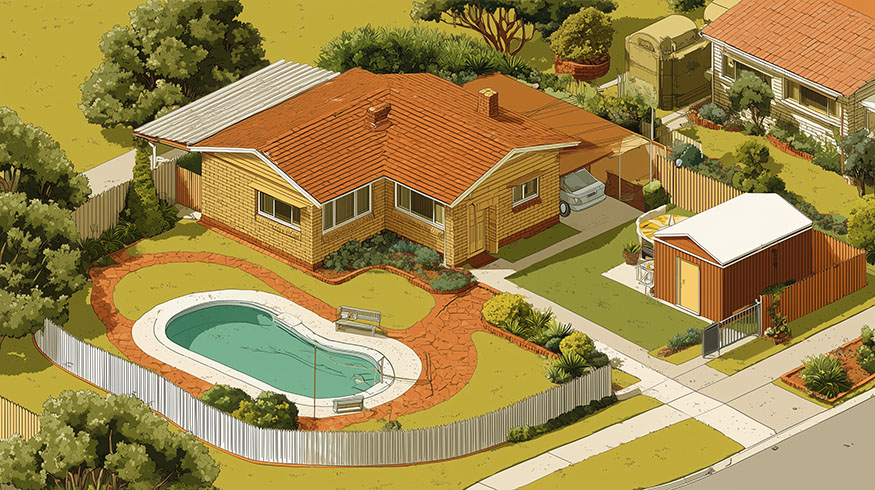
Fibreglass pools existed—they'd become widely available to Australian households in the early 1970s—but they were the affordable alternative, not the aspirational choice. The technology was new. The shapes were limited. If you wanted a "real" pool, you poured concrete.
And here's what's easy to forget: those 1970s pools were essentially chlorinated holes in the ground. No automation. No LED lighting. No smartphone controls. Manual skimmers and hope. The luxury was having a pool, not what the pool could do.
(Fun fact for the trivia-minded: saltwater chlorination was invented right here in Australia in 1971, by Ted Romer and Barry Gillings. It would eventually transform pool maintenance worldwide—but in the 70s, most pool owners were still hauling chlorine by hand.)
The 1990s killed the quarter-acre - and created the fibreglass opportunity.
The early 1990s didn't just change Australian backyards—they effectively ended them as we'd known them. Dr. Tony Hall at Griffith University documented the shift bluntly: "The provision of large backyards in new constructions ceased."
That's not hyperbole. It's what happened.
Lot coverage—the percentage of land your house sits on—flipped from a maximum of 35-40% to a minimum. Builders noticed. Australians, it turned out, would happily trade outdoor space for indoor square metres. Floor areas jumped 40% between the mid-1980s and mid-1990s, climbing toward 190m² while lot sizes started their long decline.
The McMansion emerged: multiple rooflines, double garages, media rooms, master suites with ensuites and walk-in robes. These houses were deep, square, designed to maximise interior footage. What they left behind—often under 100m², sometimes under 50m²—barely qualified as a yard at all.
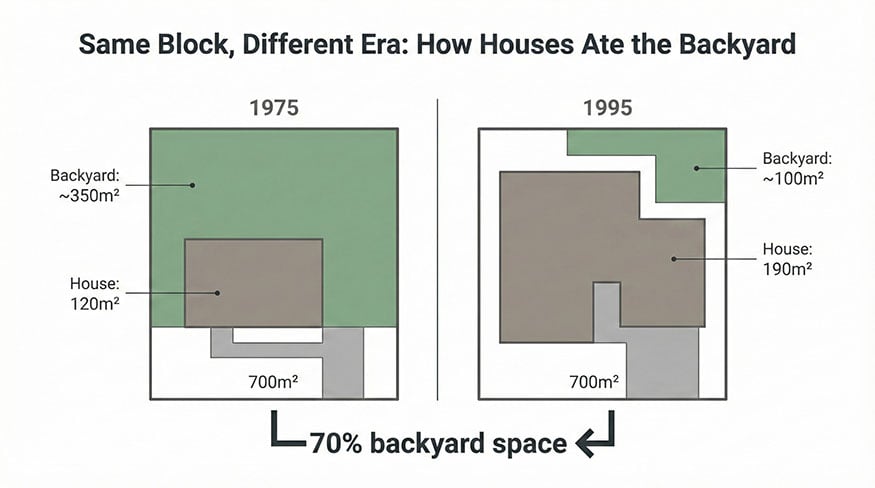 Two other forces compressed the backyard simultaneously. NSW enacted strict pool fencing legislation in 1990, requiring barriers that fundamentally changed how pools related to homes. And air conditioning became standard, making the indoors comfortable precisely as the outdoors shrank. The backyard stopped being where Australian families lived and became where they occasionally visited.
By the late 1990s, something had shifted in how Australians raised children, too. In the 1970s, 83% of parents let kids play unsupervised across neighbourhoods. By the 1990s? Twenty-five percent. The backyard had been communal, spilling over low fences into neighbours' yards. Now it was private, contained—and much, much smaller.
Fibreglass pools didn't just survive the squeeze. They were built for it.
The 2000s saw fibreglass technology come of age at exactly the moment Australian backyards needed it most.
The fibreglass industry that had spent the 1970s and 80s as the "affordable alternative" was growing up. Manufacturers developed self-cleaning systems. Production scaled globally. Structural engineering improved to the point where lifetime warranties became standard rather than aspirational. What had been a budget choice was becoming the mainstream one.
The numbers made the case. Fibreglass installation: 1-3 weeks. Sometimes as fast as seven days. Concrete? Three to six months. The cost gap was just as stark—fibreglass came in at $25,000-$50,000 installed, while concrete ran $40,000 to $100,000 or more. For homeowners watching their backyards shrink and their schedules compress, waiting half a year and spending twice as much stopped making sense.
But it wasn't just speed and cost. Fibreglass pools looked different now.
The colour revolution moved pools from white and pale blue into sophisticated finishes: blacks, dark greys, deep blues, greens. Geometric designs—rectangular with clean edges, centre entry steps, built-in bench seating—became the most popular fibreglass format in Australia. People had grown tired of kidney shapes. They wanted clean lines, something that looked intentional rather than organic.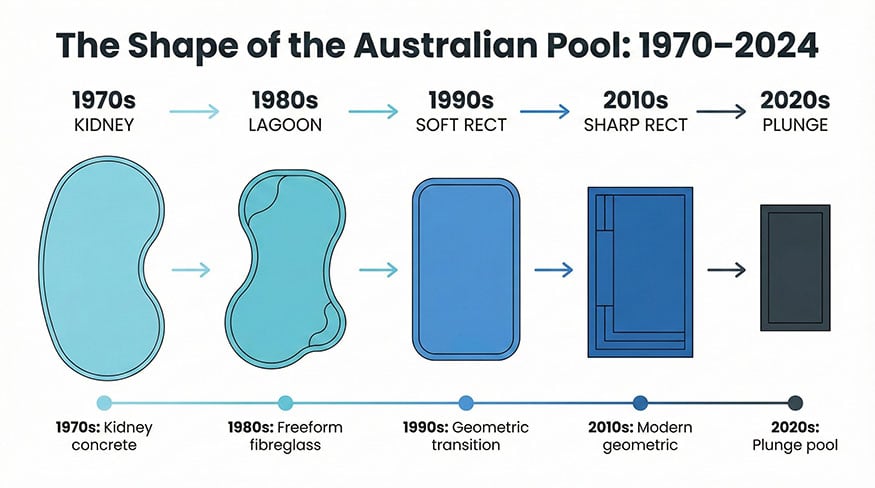 The Millennium Drought (1996-2010) accelerated everything. Water restrictions hit hard—Sydney reached Level 3, Brisbane's dams dropped below 20%, Melbourne hit Stage 3a. Pool filling required prior approval. Smaller pools weren't just practical; they were responsible. And fibreglass pools, with their faster installation and lower water volume, fit the moment.
By the 2010s, more than half of all in-ground pools installed in Australia were fibreglass. Not the budget choice anymore. The dominant choice.
You might think this story is about settling. It's not.
Right about now, you might be thinking: this is a story about settling. About the Australian dream getting smaller and learning to live with less. About choosing fibreglass because a "real" concrete pool simply won't fit—not because fibreglass is actually better.
We hear this all the time.
There's a persistent sense that concrete is premium and fibreglass is practical. That your parents' generation got the full experience, and you're getting the compressed version. That standing in your backyard with a tape measure is standing in the aftermath of something lost.
We get why it feels that way. The 1970s pool looks idyllic in memory. Sunlight on water. Kids bombing into the deep end. Space to float.
But here's what that memory leaves out: the 1970s pool was a maintenance nightmare. Painted concrete that faded chalky within years. Chemical balancing by guesswork. No heating, no automation, no lighting worth mentioning. The "deep end" was for diving, but it also meant more volume to heat (if you heated at all), more chemicals to balance, more surfaces to scrub.
The pool was impressive. The experience of owning the pool? Often frustrating.
Evolution doesn't mean smaller. It means more intentional.
Today's 4-metre fibreglass plunge pool does more than the 12-metre kidney-shaped concrete ever did.
Temperature control? Standard. LED lighting with smartphone integration? Expected. Self-cleaning systems? Available. Water quality that doesn't leave your eyes stinging and your skin tight with chlorine? Achievable.
The modern pool isn't a hole with chlorinated water. It's a temperature-controlled, light-programmable wellness feature that you manage from your phone while sitting inside. Saltwater systems (remember, an Australian invention) are now used in over 80% of pools. Magnesium mineral options have entered the market for those wanting something gentler still.
We love how the technology has caught up to the space constraints. When you can't build more pool, you build better pool - and that's exactly what happened.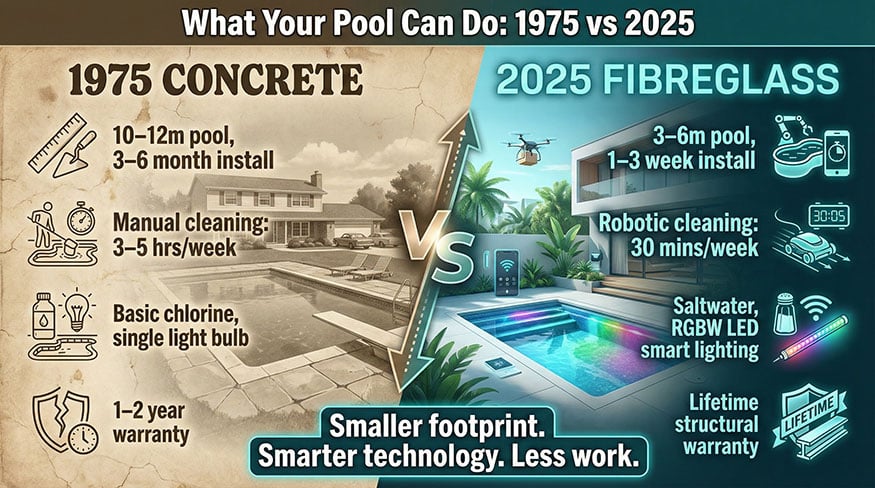
| 1970s Concrete Pool | Modern Fibreglass Pool | |
|---|---|---|
| Typical Size | 10–12 metres, kidney-shaped | 2.2m–10m+, geometric or compact |
| Installation Time | 3–6 months | 1–3 weeks |
| Installed Cost | $40,000–$100,000+ | $25,000–$50,000 (or from ~$35,000 DIY-coordinated) |
| Colour Options | White or pale blue painted finish | 12+ gel-coat colours including black, grey, deep blue |
| Heating | None or basic gas (rare) | Heat pump, solar, or gas — smartphone-controlled |
| Sanitisation | Manual chlorine dosing | Saltwater or magnesium mineral (automated) |
| Cleaning | Manual skimmer and vacuum | Robotic cleaners, self-cleaning systems |
| Lighting | None or single incandescent | Multi-colour LED with app control |
| Surface Maintenance | Repaint every 5–7 years, acid wash | Non-porous gel coat, minimal maintenance |
| Warranty | Limited or none | Lifetime structural warranty |
| Features | Diving board, deep end | Spa jets, tanning ledges, wet decks, bench seating |
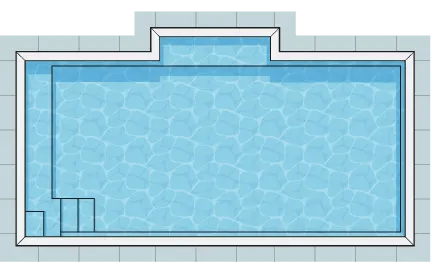
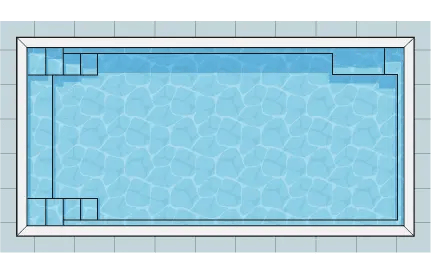
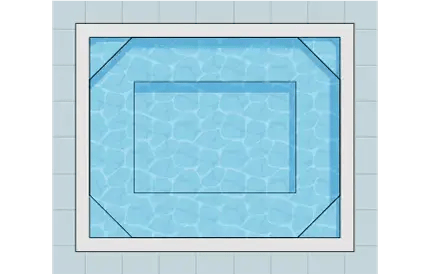
The plunge pool isn't a compromise; it's a design category that didn't exist in your parents' era because it wasn't needed. Now it's the centrepiece of modern Australian outdoor living. Pools as compact as 2.2m × 2.2m—but packed with features the 12-metre concrete never had: integrated spa jets, tanning ledges for lounging in the shallows, wet decks that blur the line between pool and patio. Semi-recessed installations work on difficult sites without engineering-heavy retaining walls. Some households now install multiple pools—recreational plus cold or hot therapy plunge—on lots that would have held one kidney-shaped concrete in 1985.
And the Australian backyard itself? It turned out the compression wasn't a loss. It was a focus shift.
The 2020s backyard isn't smaller. It's more considered.
COVID changed how Australians thought about their outdoor space—perhaps permanently. Westpac research from 2020 found 27% of Australians now prioritise backyards when home-buying. Seventy-seven percent prefer houses over apartments. The backyard, after decades of shrinking, suddenly mattered again.
But it wasn't a return to the quarter-acre. It was a recognition that what you do with outdoor space matters more than how much you have.
Pool ownership reached 14% of Australian households by 2023—3.1 million people. Regional Queensland leads at 24%, with Brisbane at 19% and Sydney at 16%. Plunge pools are now preferred by 39% of new pool buyers specifically for space efficiency.
The backyard has become the gym (shed sales rose 450% during lockdowns), the office, the entertaining venue, the wellness retreat. The fibreglass plunge pool—quick to install, efficient to run, sophisticated in finish—is the centrepiece that makes multi-function outdoor spaces work.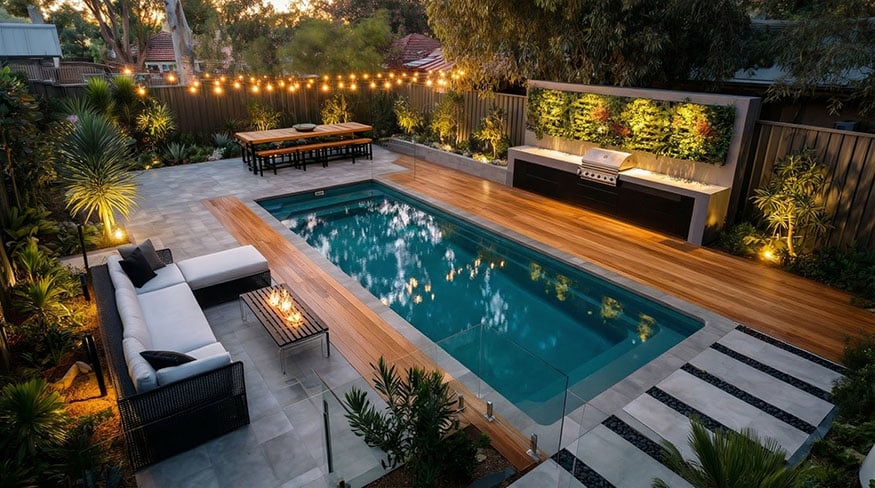 And fibreglass manufacturers haven't stood still. Warranties now extend to lifetime structural guarantees. Automation integrates with smart home systems. Finishes are indistinguishable from high-end concrete to anyone but a tradesperson. The "affordable alternative" evolved into the obvious choice for how Australians actually live now.
Back to the tape measure.
You're still standing in your backyard. The numbers haven't changed—it's still the space you've got. But maybe what changed is what you're measuring against.
This isn't the aftermath of the quarter-acre dream. It's where five decades of Australian outdoor living arrived. The block compressed, the house expanded, the pool evolved—and fibreglass emerged as the format that makes sense when every square metre has to earn its place.
Your parents' backyard had room for a Hills Hoist and a kidney-shaped concrete pool and a veggie garden and a shed. Yours has room for intention. For a pool that heats in hours instead of days, cleans itself, lights up in colours your parents' generation couldn't have imagined, and fits a space they wouldn't have recognised.
That tape measure isn't showing you what you're missing. It's showing you what's possible now.
Frequently Asked Questions
How much does a fibreglass pool cost in Australia?
A fibreglass pool typically costs $25,000–$50,000 fully installed by a pool company. Homeowners who coordinate the project themselves using a DIY kit can reduce total costs to $35,000–$45,000 — saving 40–50% compared to a full-service installation. Pool shell and equipment costs vary based on size, model, and selections — use our pool price calculator for a personalised estimate.
How long does it take to install a fibreglass pool?
The construction phase for a fibreglass pool takes 1–3 weeks, and some installations are completed in as little as seven days. Including council permits, contractor scheduling, and finishing works (coping, fencing, decking), the total process typically runs 8–12 weeks. By comparison, concrete pools take 3–6 months. Learn more about the installation process.
What is a plunge pool, and what size do they come in?
A plunge pool is a compact pool designed for relaxation, cooling off, and hydrotherapy rather than lap swimming. Modern fibreglass plunge pools start from as small as 2.2m × 2.2m and typically range up to 6 metres in length. Despite their compact size, they can include features like integrated spa jets, tanning ledges, bench seating, and LED lighting.
Is fibreglass better than concrete for a pool?
For most Australian homeowners, fibreglass offers significant advantages: installation in weeks rather than months, lower upfront cost ($25,000–$50,000 vs $40,000–$100,000+), a non-porous surface that resists algae and requires less chemical maintenance, and lifetime structural warranties. Concrete may suit very large or highly custom shapes, but fibreglass now accounts for more than half of all in-ground pools installed in Australia.
Can I install a fibreglass pool myself in Australia?
You can coordinate the project yourself and save $25,000–$40,000 — but certain work must be done by licensed professionals. Plumbing, electrical, excavation over 1.5m, crane operation, and pool barrier installation all require licensed tradespeople. The homeowner's role is project coordination: organising quotes, scheduling contractors, and supervising key stages. It takes roughly 8–15 hours of your time over the project. Read our full guide on DIY vs fully installed.
What equipment do I need for a fibreglass pool?
Essential pool equipment includes a pump, filter, chlorinator (saltwater or mineral), and lighting. Most suppliers offer packages — from Signature packages with robotic cleaners to Fresh Water packages using magnesium mineral systems for chlorine-free swimming. The pump should circulate the full pool volume every 4–6 hours, and the filter should handle 1.5× the pool volume.
About the Author
Colm Walsh is the Managing Director of Swimming Pool Kits Direct. A former national-level competitive swimmer and water polo captain at University College Cork, he spent 20+ years in digital and e-commerce leadership at Amazon, Accenture, NAB, and Optus before acquiring the business in 2020. Swimming Pool Kits Direct has delivered thousands of fibreglass pool kits to Australian families over the past 10+ years. Learn more about our team.
Wondering what's possible in your space? We're here to help you figure out exactly what fits - and what that fit can actually do. Talk to us.

.png?width=400&height=266&name=Lap%20Pool%20(2).png)
.png?width=400&height=266&name=Blog%20Images%20(7).png)
.png?width=400&height=266&name=Beat%20The%20Price%20Rise%20(1).png)
